Saved by StormPave Permeable Pavers
Words: Dan KamysOctober 2014
Case Study >>> Hardscaping
By Walt Steele
The problem came on rainy days in Lancaster, Pa. Stormwater and sanitary sewage ran together in the same lines. When it was sunny, there was no problem. If it rained, the additional volume overwhelmed the sewage treatment plant.
As it turned out, an installation of Pine Hall Brick Co.’s StormPave permeable pavers was part of the solution, which has attracted some attention.
Earlier this year, an installation of the pavers was one of the key features in an upgrade of the intersection of Plum and Walnut streets in Lancaster, Pa. The Chesapeake Stormwater Network announced that the project won the Grand Prize – the Best Urban BMP (Best Management Practice) in the Bay Award, or BUBBA.
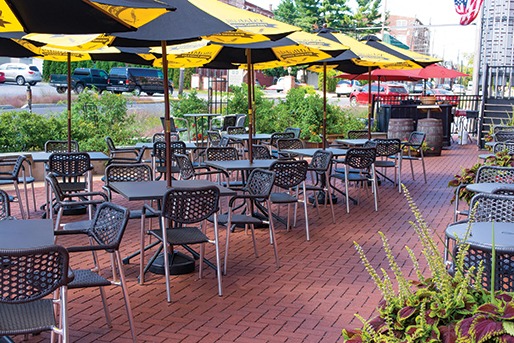
The stormwater network said the project effectively transformed a low-lying intersection that had a large concrete island and a dangerous merge lane into a model for stormwater management, with enhanced pedestrian amenities, improved traffic safety and increased commercial activity. A large outdoor dining patio with StormPave pavers was built at the Lancaster Brewing Co. A short distance away, diagonal parking spaces made of StormPave pavers, with contrasting pavers used for stripes, was installed.
The once concrete and asphalt intersection is now home to native shrubs, perennials, ornamental grasses and new tree species surrounding the outdoor caf??. Adjacent to the dining patio is a sculpture with a framework of steel and irregular native woods that hides a 700-gallon cistern. The installation captures stormwater from the roof for watering planters that are used by the brewery’s owners to grow their own produce.
The stormwater network, consisting of nearly 4,000 stormwater professionals throughout the Chesapeake Bay Watershed, which runs from New York south through most of Pennsylvania, Maryland, the District of Columbia and Virginia, began the competition to recognize innovative approaches to handle stormwater.
The group is made up of engineers, planners, researchers and environmental advocates. They are trying to find out what works and share that knowledge with others. Those methods can be adapted for use in their own communities. The overall goal is to clean up the Chesapeake Bay.
The competition was divided into several categories that examined a wide range of projects, including relatively small ones intended for residential homeowners and those much larger, to restore wetlands and create habitat for wildlife. The category that the Plum and Walnut streets project won was in the Ultra-urban BMP category.
According to the competition rules, such projects are in urban areas with more than 75 percent of impervious cover and had to demonstrate how well they achieved a high runoff/pollutant removal rate; create an attractive site, and effectively overcome the infrastructure, utility, traffic and other challenges of the ultra urban environment.
John McGrann, owner of Penn Stone, a Pine Hall Brick Co. dealer, said that the use of permeable paving is seeing increased popularity in the area around Lancaster, in part because of how Lancaster’s stormwater infrastructure was designed.
Like many of the older inland cities in the United States, Lancaster has a drainage system that combines stormwater with raw sewage. McGrann said that on a sunny day, it’s not a concern. On a rainy day, the combination of stormwater and sewage overwhelms the treatment plant, which results in pollution being released into the Conestoga River. From there, it goes into the Susquehanna River and, finally, into the Chesapeake Bay.
McGrann says that the project at Plum and Walnut streets makes good economic sense, on a couple of different levels. He said that the City of Lancaster is under a mandate from the Environmental Protection Agency (EPA) to either come up with a way to solve the problem, or the EPA will require the city to build a series of expensive gray-water holding tanks. The tanks are designed to hold the wastewater to give the treatment plant time to treat all of it before it’s discharged into the river.
“We can either spend the money or we can explore the alternatives that are out there,” says McGrann. “We can get in compliance with the EPA requirement through a strategy of green infrastructure for half the investment and create some interesting infrastructure in the process.”
McGrann says that early examples, in addition to the street project, have included the use of porous pavement, instead of solid asphalt, to build basketball courts; and a combination of porous pavement and permeable pavers to replace an alleyway.
“From what I hear, we’re getting held up as an example of discovering good solutions instead of being confrontational and getting forced into a bad solution,” says McGrann.
He added that another example of a good investment was the Pine Hall Brick StormPave paver itself. The job was originally specified with a reddish concrete paver, but McGrann made the point to the city that a red clay paver would be more authentic; would be more architecturally consistent with the red brick buildings that date from the 1880s; and would make better sense financially – even if more expensive in the beginning. It will last virtually forever, and its color will never change.
“With the lifespan, with the long-term aesthetics, if you had to spend a little bit more up front, the real value proposition was the life-cycle cost and being true to the historic character of that location and the city in general,” says McGrann. “It was the right thing to do.”
Walt Steele is a paver business manager for Pine Hall Brick Co., a manufacturer of genuine clay pavers. The company has plants in Madison, N.C., and Fairmount, Ga. Its corporate headquarters is at 2701 Shorefair Drive N.W., Winston-Salem, NC 27105. Steele can be reached at 800-334-8689 or waltsteele@pinehallbrick.com. For more information, please visit www.PineHallBrick.com.
Return to Table of Contents