Side Story: Editor's Pick - StormPave Brick Pavers
Words: Dan Kamys
Brick
Pavers go beyond sustainability to water conservation and purification.
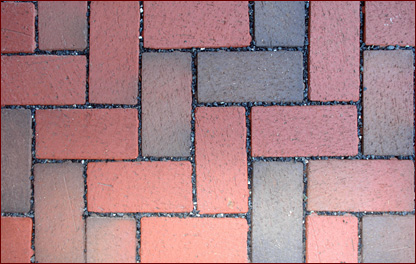
It's widely known that brick pavers are sustainable building products. Pine Hall Brick has two new paver products that reach beyond sustainability to a tool for conserving and purifying water.
The new pavers, RainPave and StormPave, are brick pavers for use in a permeable paving installation system in driveways, parking lots and sidewalks. The pavers allow water to dissipate into watersheds, instead of running down storm drains into streams and rivers, picking up pollutants along the way.
RainPave, for residential use, and StormPave, for commercial applications, look similar to pavers Pine Hall Brick has offered for decades. Where they differ is in the spacing between the pavers and a specially constructed paving system underneath the surface, which enables water to filter through instead of flowing over the pavers. Instead of a gravel and sand base, and sand swept into the joints, a #2 stone is used as a sub-base. Then, a base of #57 stone is used, followed by a bedding layer of #8 aggregate, which is also swept into the joints.
RainPave and StormPave are particularly useful not only among residential customers and developers who are concerned with the environment, but also in communities where local regulations mandate the size of hard-surface ground applications.
In cities like Atlanta, for example, the development of larger houses on smaller lots has led to local ordinances limiting the size of areas, like concrete driveways, that don't allow water infiltration.
In appearance, the RainPave pavers look like traditional rumbled clay pavers, while StormPave pavers are designed to look like traditional English Edge pavers, but with larger spacer nibs. StormPave works well in institutional and commercial projects, when joint openings need to meet Americans With Disabilities Act restrictions; impervious surface restrictions apply; and onsite retention/infiltration is mandated.
For some commercial applications, the permeable pavements replace retention ponds, enabling developers to build on more land.
The development of the new pavers was based on marketplace demand. Increasingly, homeowners are embracing green building materials, products and processes. In the commercial marketplace, clients are increasingly focusing on storm water runoff and earning the U.S. Building Council's LEED certification.
In commercial applications, the StormPave pavers qualify for the U.S. Building Council's LEED certification credits under storm water design.